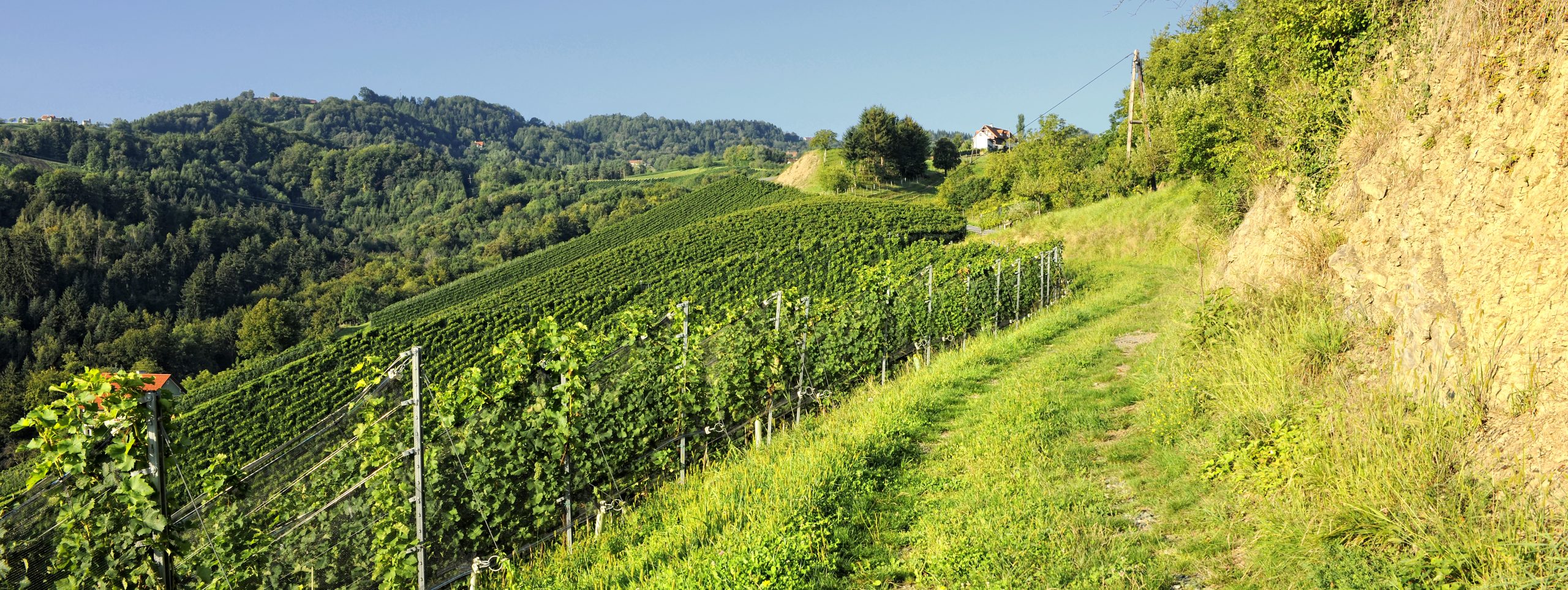
Having vineyards with terrific soil conditions is not enough on its own.
An equally important component is the way we cultivate our vineyards. > Terroir is based on the climate, on the soil and on the people, cultivating it.
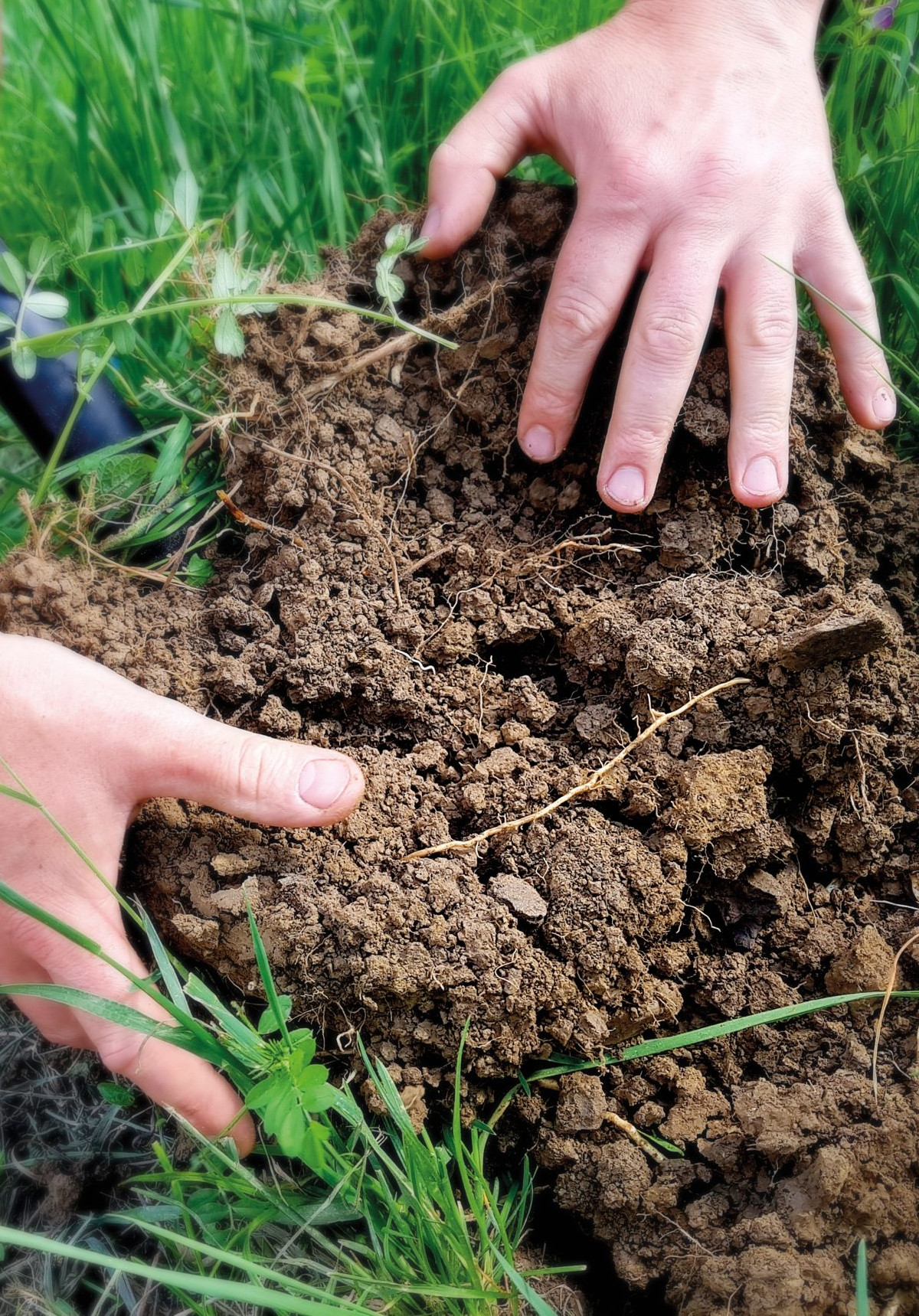
Geology, soil, and climate results in an independent mixture of microorganisms.
Based on strains of microorganisms, different origins can be clearly distinguished from each other. Studies have shown that microorganisms in grape juices can be used to identify the origin of the grapes. Typical aromas, styles and vineyard potentials are results of them.
OUR PHILOSOPHY
Humans exert a great influence with their way of cultivating.
Natural soil management, support for plant health and working of 100 percent organic is very important for us.
The spontaneous fermentation, only with natural yeasts, ensures the creation of wines reflecting their terroir. This also explains why we do not use any selected yeasts.
If you accompany the way of natural winemaking, taking as little influence as possible in natural processes, then this wine reflects the most traceable origin.
And this is exactly what our philosophy is based on: Our wines reflect our terroir.
OUR PHILOSOPHY IS BASED ON THE KEYWORD “ORIGIN”.
“ORIGIN” MEANS “NATURAL PROCESSES”, “WINE-GROWING AREAS”, “TERROIR”. (Patrizia & Erwin Sabathi)
“Origin”, for us the most important quality feature.
The character and the quality of our wine depend on the origin.
To explain our sophisticated quality philosophy, the word “origin” is defined in several other words on the following pages:
“Origin” – interpreted as “terroir”
The “birth” of great wine is in the vineyard

“Origin” – interpreted as “nature”, “natural” and “close to nature”
Working in harmony with nature

“Origin” – defined by one, uniform system of origin
The STK-System of Origin/Südsteiermark DAC
“Origin” – specified by our “single vineyards”
Our wine-growing areas
The terroir is predominant . . .
THE GROWING AREAS OF OUR WINES
The base to vinify great wine is a perfect terroir – our wine is representative of our terroir:
Representing the vineyard-locations, climate and the soil conditions of our vineyards in Southern Styria.
The “birth” of great wine is in the vineyard.
This means that “winemaking” already starts in the vineyards because the quality of the vines and their grapes primarily, secondly and thirdly depend on the quality of the terroir where the vines are growing.
The next important steps of vinification are the management of working in the vineyards and the handling in the wine cellar.
Here again, we count on the terroir and on the nature. Both are superior to human.
For us, the main focus is based on:
How can we support natural dynamics at best and let nature takes its course?
How can the terroir be expressed in our wine at best?
The making of wine is a craft, down-to-earth and close to nature – nature is an enormously valuable heritage, this needs to be respected.
“OUR AIM IS A MAXIMUM OF QUALITY, A NATURAL, SELF-REGULATING YIELD REDUCTION AND TO HARVEST HEALTHY, PERFECT MATURED GRAPES. THIS CAN ONLY BE ACHIEVED BY AN APPROPRIATE BALANCE BETWEEN SOIL AND VINES.”
(Erwin Sabathi)
Affected by natural processes . . .
THE DEVELOPMENT OF OUR WINES
All grapes are harvested by hand,
all vineyards are cultivated according to organic guidelines,
all wines are exclusively fermented with natural yeasts.
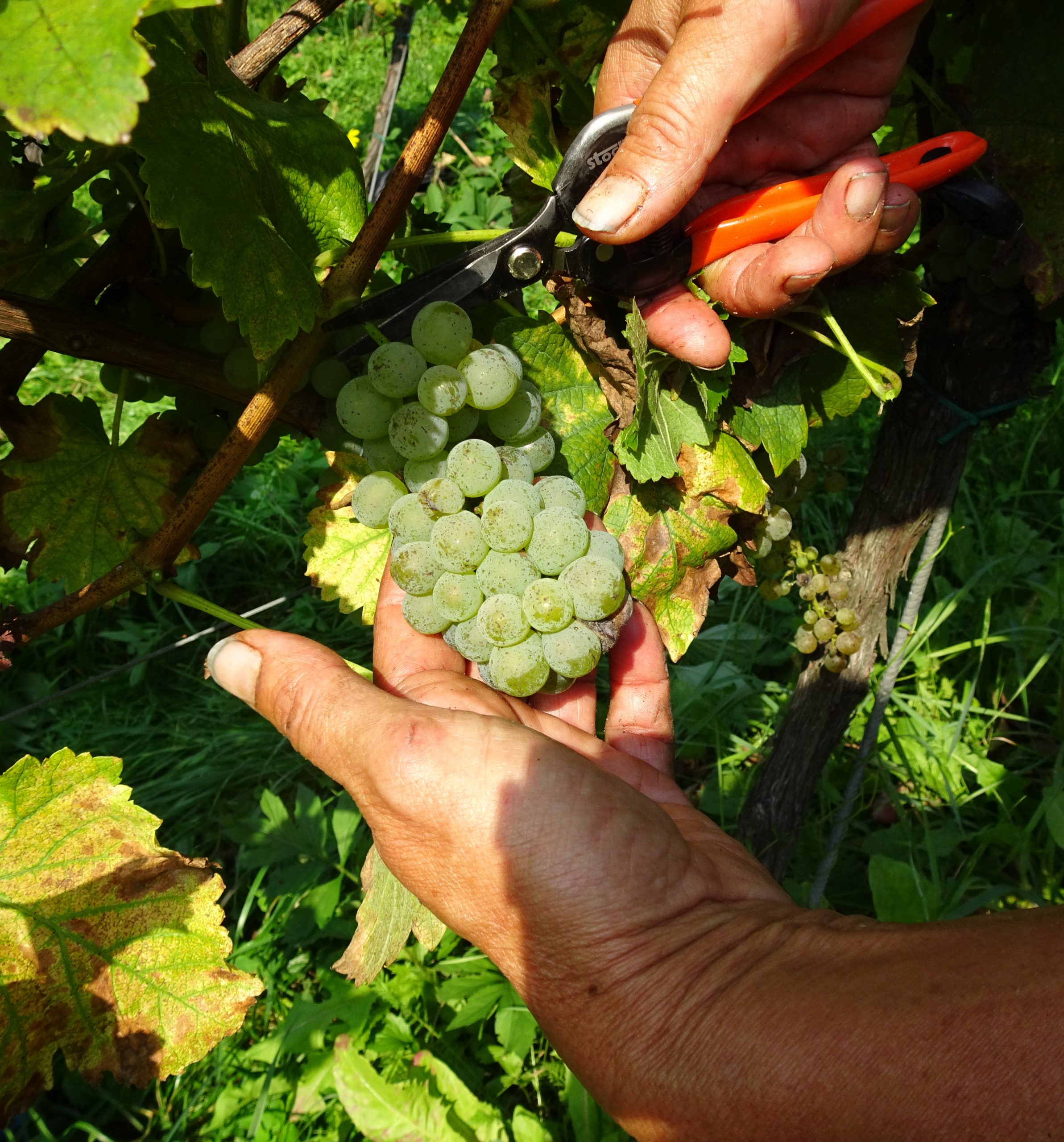
The harvest of our grapes is the most important time of the wine year, at the same time the most critical time. Only by a very careful selection, the grapes deliver the high quality of our vines into the cellar.
Due to a very high inclination, our extremely steep vineyards need to be harvested by hand, which is the original and traditional way of the grape harvest.
However, for us, quality is an even much more important reason.
The manual harvest is an essential condition and a very deliberate decision of us to highlight our quality features:
Manual harvest – every ripe grape is cut by hand.
Manual harvest – as a result, our grapes are harvested completely undamaged.
Manual harvest – it is possible to choose only the most mature grapes.
Manual harvest – it is possible to sort out berries/grapes already during the harvest that do not meet our quality standards.
Our winery is certified organic.
Moreover, for us it is of high importance to operate: In harmony with nature, in consideration of ecological aspects, with a high regard for environmental protection.
In the management of our vineyards we rely on absolutely nature-friendly treatment measures, in the vinification only on natural processes.
We vinify our wine in harmony with nature.
Natural yeasts, also called “wild yeasts”, or “wild wine yeasts”, occur in the natural environment of wine. They live in the vineyards, on the vines, in the wine cellar and are deposited on the grape skins. By this way these yeasts get into the grape juice and effect spontaneously an alcoholic fermentation without influence of the winegrower, and this is defined as spontaneous fermentation.
The spontaneous fermentation, a natural microbiological process, is the most natural and original form of winemaking.The natural yeasts, living in natural surroundings, are optimally adapted to the respective conditions. The in a wine cellar existing yeast population is composed of different strains. Each yeast strain is essential in the fermentation process. This natural interaction creates a complex wine. There is no better way to use even these processes of the nature to bring the nature into the wine cellar.
The spontaneous fermentation, (fermentation only with natural yeasts), ensures the creation of wines reflecting their terroir. Furthermore, due to the spontaneous fermentation the expression of natural aromas in the wine is much more better and fruitier.
The spontaneous fermentation is one of our steps to transmit the inimitable, unique character of a vineyard to the taste of a wine and to present an identifiable taste of the wine-growing area.
Visualised by the Classificationpyramid . . .
THE ORIGIN OF OUR WINE
“Origin” – defined by one, uniform system of origin
The STK-System of Origin/Südsteiermark DAC
Where our vines flourish . . .
OUR WINE-GROWING AREAS
“Origin” – specified by our “single vineyards”
Our wine-growing areas
Spring
The soil life is very essential for working with nature.
Here are the first impressions of the new year: the sprouting of our vines, the planting of new vines and the pruning of our young plants.
In the cellar the new vintage is going to be bottled. In this video you can see the bottling of our single vineyard wines and the bottling of our big bottles.
Summer
There is a lot of work in the vineyard all year round.
In this video the summer work in our vineyards and a soil sample from Pössnitzberg are shown.
Autumn
Now the harvest is imminent.
Enjoy the views over the beautiful landscape of the Southern Styria and get insights of the laborious manual harvest in our extremely steep vineyards.
Winter
There is no winter rest – there is a lot to do all around the year, in the vineyard as well as in the wine cellar.
This video illustrates the work in the barrel cellar and shows the wintry pruning.